If you are building a house in Nigeria, one of the questions you will probably ask before buying materials is: how many blocks can a bag of cement lay?
Knowing the answer can help you estimate your cement requirements, control construction costs, reduce material waste, and avoid running out of cement halfway through a wall.
However, there is no single number that applies to every building project. The number of blocks that one 50kg bag of cement can lay depends on several factors, including the size of the blocks, the cement-to-sand ratio, the thickness of the mortar joints, the quality of workmanship, and how efficiently the mortar is used.
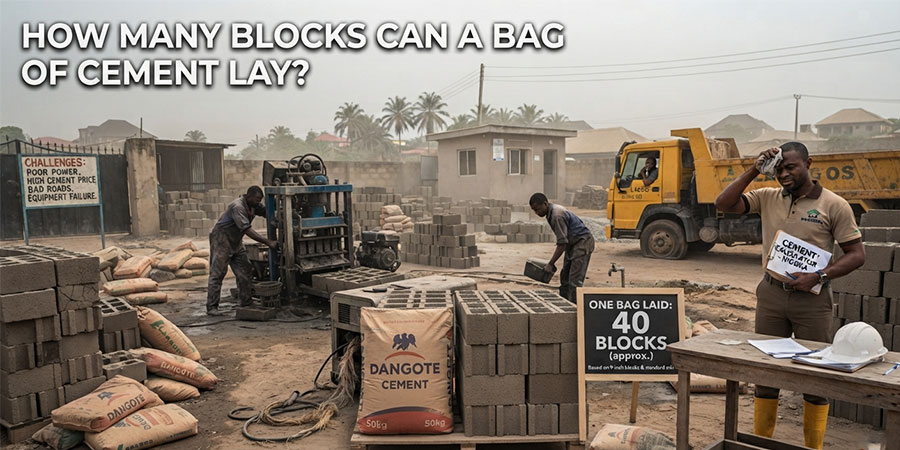
For a typical Nigerian building project, a reasonable planning range is often around 35 to 50 standard blocks per 50kg bag of cement, depending on block size and site conditions. Some estimating guides use approximately 35 blocks for 9-inch blocks and 40 blocks for 6-inch blocks, while an engineering calculation for 9-inch hollow block walls arrived at approximately 50 blocks per bag under its stated assumptions.
This guide explains how to estimate your requirements more accurately and what you should consider before purchasing cement.
What Does “How Many Blocks Can a Bag of Cement Lay” Mean?
The question how many blocks can a bag of cement lay refers to the number of already manufactured blocks that can be joined together using the mortar produced from one bag of cement mixed with sand and water.
It is important to distinguish this from the number of blocks that can be produced or moulded from a bag of cement.
These are two different calculations.
For example:
Block laying: cement is mixed with sand and water to make mortar for joining blocks.
Block production: cement, sand, water, and the appropriate production method are used to manufacture the blocks themselves.
The amount of cement required for these two activities is not the same.
In Nigeria, standards and industry guidance have also highlighted the importance of using adequate cement content when producing quality sandcrete blocks. One report on training conducted with block moulders stated that 24 blocks from a 50kg bag was the agreed production figure for the specified mix, while producing substantially more blocks was considered likely to compromise quality.
Therefore, when someone asks how many blocks a bag of cement can lay, they are normally asking about mortar for wall construction, not block manufacturing.
How Many Blocks Can a 50kg Bag of Cement Lay?
For general estimating purposes, one 50kg bag of cement can often lay approximately:
| Block type | Approximate blocks per 50kg bag |
|---|
| 4-inch block | 45 to 60+ |
| 6-inch block | 35 to 45 |
| 9-inch block | 30 to 50 |
| Large or unusually thick blocks | May be lower |
These figures are estimates rather than guaranteed quantities.
A current Nigerian construction estimating guide gives approximately one bag per 35 9-inch blocks and one bag per 40 6-inch blocks using a 1:6 mortar ratio.
Meanwhile, an engineering review calculated approximately one bag for 50 pieces of 9-inch hollow block under its particular assumptions about mortar volume and mix.
This difference demonstrates why simply memorising a number can result in inaccurate material estimates.
A Practical Figure for 9-Inch Blocks
For a homeowner planning a project, 35 to 45 9-inch blocks per 50kg bag can be a useful conservative budgeting range when estimating mortar requirements.
If your bricklayer uses thicker joints, wastes mortar, or works with uneven blocks, your actual consumption may be higher.
If the blocks are uniform, the wall is properly aligned, mortar joints are controlled, and the mix is efficiently prepared, the same bag may cover more blocks.
A Practical Figure for 6-Inch Blocks
For 6-inch blocks, approximately 35 to 45 blocks per 50kg bag is also a useful planning range, although the exact number depends on the dimensions and configuration of the blocks.
Some Nigerian estimating references use approximately 40 blocks per bag for 6-inch block laying.
Do not use this figure as a substitute for a project-specific quantity estimate.
Why Does the Number of Blocks Per Bag Vary?
Several factors determine how far one bag of cement will go.
1. Block Size
Block dimensions have a direct effect on mortar consumption.
A wall constructed with larger blocks may require fewer blocks overall, but the mortar requirement per block can be different.
Common Nigerian building projects use 6-inch and 9-inch hollow blocks, particularly for partition and external walls. The appropriate block type should be selected according to the building design and the engineer’s specifications.
2. Mortar Mix Ratio
The cement-to-sand ratio is one of the most important factors.
A commonly referenced mortar mix for block laying is 1:6, meaning one part cement to six parts sand by volume. A Nigerian standard material specification also describes sandcrete block production using a 1:6 cement-to-sand ratio under specified conditions.
Changing the mix changes the quantity of cement used.
For example, using a richer mix means more cement is consumed for the same quantity of mortar. Using too much sand to stretch the cement may reduce the strength and durability of the mortar.
The correct mix should therefore be determined according to the project requirements rather than simply trying to maximise the number of blocks laid per bag.
3. Thickness of Mortar Joints
The thickness of the mortar joint makes a significant difference.
If the mortar joints are unnecessarily thick, more mortar is required. If joints are properly controlled, cement consumption can be reduced without compromising workmanship.
However, reducing mortar simply to make one bag lay more blocks is not a good construction strategy.
The objective should be to achieve the required strength, alignment, bonding, and durability while using materials efficiently.
4. Quality of the Blocks
Blocks are not always identical.
Some may have irregular surfaces, damaged edges, inconsistent dimensions, or variations caused by poor moulding.
Uneven blocks can increase mortar consumption because the bricklayer needs more mortar to compensate for irregularities.
Quality blocks with consistent dimensions make it easier to maintain uniform mortar joints.
5. Bricklayer’s Experience
Workmanship can have a major effect on cement consumption.
An experienced mason generally knows how to spread mortar evenly and maintain consistent joints. Poor workmanship can result in excessive mortar being applied, spilled mortar, improperly filled joints, and unnecessary material waste.
This is why two workers can sometimes use different amounts of cement to complete the same wall.
6. Sand Quality
The type and condition of the sand also matter.
Clean, suitable construction sand should be used. Sand containing excessive clay, organic matter, salt, or other contaminants can affect mortar quality.
The water content also matters. Adding excessive water can make mortar easier to spread initially, but it does not mean the resulting work will be stronger.
How to Calculate Cement for Block Laying
A simple way to estimate cement requirements is to first determine the number of blocks required and then divide that number by your expected blocks-per-bag figure.
For example, suppose you need to lay 1,000 9-inch blocks.
If your project estimate is 40 blocks per bag:
1,000 ÷ 40 = 25 bags
You would therefore estimate approximately 25 bags of cement for block laying.
However, it is wise to include an allowance for waste and site variations.
If you allow 10 percent:
25 × 10% = 2.5 bags
You could therefore budget approximately 28 bags rather than buying exactly 25.
A Nigerian construction calculator similarly recommends adding a wastage allowance when estimating cement requirements for block laying.
The exact allowance should depend on the project, site conditions, workmanship, storage, and procurement arrangements.
Example: Estimating Cement for 500 Blocks
Imagine you need to lay 500 blocks.
Using an estimate of 40 blocks per bag:
500 ÷ 40 = 12.5 bags
Because cement is purchased in whole bags, you would need at least 13 bags based on this simple calculation.
With an additional allowance for waste and variation, you might budget approximately 14 bags.
The final quantity should be confirmed by the project supervisor, quantity surveyor, builder, or engineer based on the actual block dimensions and mortar specification.
Example: Estimating Cement for 1,000 Blocks
For 1,000 blocks at 40 blocks per bag:
1,000 ÷ 40 = 25 bags
At 35 blocks per bag:
1,000 ÷ 35 = approximately 28.6 bags
That means your estimate could range from roughly 25 to 29 bags before adding an allowance.
This illustrates why asking only “how many blocks can a bag of cement lay?” may not provide enough information for accurate project budgeting.
How Much Sand Is Needed?
Cement is only one part of the mortar.
You also need an appropriate quantity of sand and clean water.
A standard material specification referenced for sandcrete work describes a 50kg bag of cement with approximately 0.20 cubic metres of sand at a 1:6 cement-to-sand ratio for block production.
For block laying, however, the actual sand requirement depends on the mortar mix, measurement method, moisture content, block dimensions, joint thickness, and site practice.
It is better to measure sand consistently using an approved gauge box or another agreed site measurement method rather than estimating quantities by random shovel loads.
Is It Better to Use More Cement?
Not necessarily.
A common mistake is assuming that adding more cement automatically makes every part of a building better.
The correct cement content depends on the intended application and specified mix.
Using too little cement can produce weak mortar. Using an unnecessarily high cement content can increase costs without providing an appropriate benefit for the application.
The most important objective is to follow the specification provided by the responsible construction professional.
Why You Should Not Try to Stretch One Bag Too Far
Construction costs are important, especially when cement prices are high.
However, trying to make one bag of cement lay an unusually large number of blocks can lead to poor workmanship if it is achieved by reducing cement content or using excessive sand.
A wall may appear acceptable immediately after construction but develop problems later.
Possible problems include:
- Weak mortar joints
- Poor bonding between blocks
- Cracking
- Water penetration
- Increased deterioration
- Poor resistance to weather
- Reduced durability
For this reason, material savings should never come at the expense of the construction specification.
Final Answer: How Many Blocks Can a Bag of Cement Lay?
So, how many blocks can a bag of cement lay?
For a typical 50kg bag in Nigeria, a reasonable general estimate is about 35 to 50 blocks, but the actual number can be higher or lower depending on block size, mortar ratio, joint thickness, block quality, sand quality, and workmanship.
For budgeting purposes, using a conservative figure such as 35 to 40 blocks per bag can provide a safer starting point, particularly when you do not yet have precise site measurements.
Remember that this calculation is for laying blocks with mortar, not manufacturing blocks.
The best approach is to calculate your total block requirement, establish the specified mortar mix, estimate cement consumption, and then add a sensible allowance for waste. For large residential or commercial projects, have the final quantities checked by a qualified building professional or quantity surveyor.
Need Quality Blocks for Your Building Project?
Getting the cement estimate right is only part of building a durable wall. The quality, dimensions, strength, and curing of the blocks you purchase are equally important.
If you are looking for quality blocks for your next construction project, visit blockindustry.com.ng to explore your options and connect with a reliable block supplier.